Biography ~ Unreal Mad

Quote

Chase the fire in your soul, not the comfort of the crowd.

Showing posts with label Biography. Show all posts

Monday, July 18, 2011

Vikram A Sarabhai (1919-1971)

Vikram Sarabhai was the main personality behind the launching of India’s first satellite, ‘Aryabhatta’. He is considered as the ‘father of the Indian Space Programme’. Vikram Ambalal Sarabhai was among the few scientists who devoted their entire life to the progress of science in our country.


Vikram Sarabhai was born on August 12, 1919 at Ahmedabad, Gujarat to Shri Ambalal Sarabhai and Smt. Sarladevi Sarabhai, in a family of Industrialists. His father Ambalal Sarabhai was an affluent industrialist and owned many mills in Gujarat. Vikram Sarabhai was one of the eight children of Ambalal and Sarla Devi. He had his early education in a private school. Here atmosphere injected into the young by the seeds of scientific curiosity, ingenuity and creativity. From this school he proceeded to Cambridge for his college education and took the tripods degree from St. John’s College in 1940. When World War II began, he returned home and joined as a research scholar under Sir C.V. Raman at the IISc IISc, Bangalore. In September, 1942 Vikram Sarabhai married Mrinalini Sarabhai who was a celebrated classical dancer of India. The wedding was held in Chennai without anyone from Vikram’s side of the family attending the wedding ceremony because of the ongoing Quit India movement led by Mahatma Gandhi. Vikram and Mrinalini had two children – Kartikeya and Mallika. Mallika Sarabhai is a renowned dancer.


He started his work on cosmic rays and built the necessary equipment with which he took measurements. He returned to Cambridge in 1945. In 1947 he was awarded the Ph. D. degree. The physical Research Laboratory (PRL) was established in November 1947 in a few rooms in M.G. Science Institute of the Ahmedabad Education Society, which was founded by his parents. Subsequently, it got support from the Council of Scientific and Industrial Research (CSIR) and the Department of Atomic Energy.


His interest in solar Physics and cosmic rays led him to set up many observation stations around the country. Vikram Sarabhai established centers for scientific research in several places of India. He was instrumental in establishing the physical Research Laboratory (PRL) in Ahmedabad. In this, he formed the ‘Group for the Improvement of Science Education’, in 1963. In the same year, he established the Nehru Foundation for Development, for the study of social and education problems.


In 1966, under its auspices, he established the Community Science Center, whose object was to spread scientific knowledge, to create interest in science and to promote experimentation among students, teachers and the general public. After the sudden death of Dr. Sarabhai in 1971, the then Prime Minister of India, Smt. Indira Gandhi, renamed the Centre as the Vikram A. Sarabhai Community Science Centre, to associate its name with that of its founder. To train efficient managers of factories, he started the Indian Institute of Management (IIM) at Ahmedabad. Of all the institutions, he established the most important were the ‘Indian Space Research Organization’ with Centers at Thumba, Ahmedabad, Shriharikota and Arvi. He established Rocket Launching Stations at Thumba and Shrihatikota. Along with his work on the science front, he took utmost interest and managed family business of Textiles and Pharmaceuticals.


He was also responsible for the Equatorial Rocket Building Station at Thumba. Sarabhai set up the Ahmedabad Textile Industries Research Association, a laboratory for research in physics and the Indian Institute of Management. Sarabhai was the second chairman of India’s Atomic Energy Commission and the Indian Space Research Organization (ISRO). Sarabhai’s study of cosmic rays under the eminent scientist Dr. C.V.Raman revealed that cosmic rays are a stream of energy particles reaching the earth from the outer space, being influenced on their way by the sun, the atmosphere and magnetism. This study helps in observing terrestrial magnetism and the atmosphere, the nature of the sun and outer space. He was conferred ‘Padma Vibhushan’ in 1972. He was also awarded ‘Dr. Shanti Swarup Bhatnagar Medal in Physics’ in 1962.


The establishment of the Indian Space Research Organisation (ISRO) was one of his greatest achievements. He successfully convinced the government of the importance of a space programme for a developing country like India after the Russian Sputnik launch.


Dr. Homi Jehangir Bhabha, supported Dr. Sarabhai in setting up the first rocket launching station in India. This center was established at Thumba near Thiruvananthapuram on the coast of the Arabian Sea, Primarily because of its proximity to the equator. After a remarkable effort in setting up the infrastructure, personnel, communication links, and launch pads, the inaugural flight was launched on November 21, 1963 with a sodium vapour payload.


As a result of Dr. Sarabhai’s dialogue with NASA in 1966, the Satellite Instructional Television Experiment (SITE) was launched during July 1975-July 1976 (When Dr. Sarabhai was no more). Dr. Sarabhai started a project for the fabrication and launch of an Indian Satellite. As a result, the first Indian satellite, Aryabhatta, was put in orbit in 1975 from a Russian Cosmodrome.


Dr. Sarabhai was very interested in science education and founded a Community Science Centre at Ahmedabad in 1966. Today, the Centre is called the Vikram. A. Sarabhai Community Science Centre. This great scientist could be credited with launching India into space age. Vikram Sarabhai died at the age of 52 on December 31, 1971 at Kovalam,
Thiruvananthapuram, Kerala.


Vikram Sarabhai scientist


Vikram Sarabhai Picture


Scientist Vikram Sarabhai photo


Scientist Vikram Sarabhai Wallpaper


Great Scientist Vikram A Sarabhai photo

Wednesday, February 2, 2011

Stephen Hawking

The Living God of the Era also known as Junior Einstein


Born Jan 8, 1942 in Oxford, England. The eldest of Frank and Isobel Hawking’s 4 children, Stephen William Hawking was born upon the 300th anniversary of the death of Galileo, which has prolonged been a source of honour for the remarkable physicist. Stephen was born in to a family of thinkers. At a time when couple of women suspicion of starting to college, the Scottish born Isobel warranted her approach in to Oxford University in the 1930s, creation her a single of the college’s initial womanlike students. Frank Hawking, an additional Oxford graduate, was a reputable healing researcher with a featured item in pleasant diseases.
Stephen Hawking’s bieing born came at an inappropriate time for his parents, who didn’t have many money. The domestic meridian was additionally tense, as England was traffic with World War II and the assault of German bombs. In an bid to find a safer place to have their initial child, Frank changed his profound wife from their London home to Oxford. The Hawkings would go upon to have dual alternative children, Mary (1943) and Philippa (1947). A second son, Edward, was adopted in 1956.
The Hawkings, as a single tighten family crony described them, were an “eccentric” bunch. Dinner was mostly eaten in silence, any of the Hawkings earnestly celebration of the mass a book. The family automobile was an aged London cab and their home in St. Albans was a three-story fixer-upper which never utterly got fixed. The Hawkings additionally kept bees in the basement, and done fireworks in the greenhouse.
In 1950, Stephen’s father took work as the conduct of the Division of Parasitology at the National Institute of Medical Research, and outlayed the winter months in Africa you do research. He longed for his oldest kid to go in to medicine, though from an early age Stephen showed a passion for scholarship and the sky. That was clear to his mom who, along with her children, mostly spread out out in the backyard upon summer evenings to glance up at the stars. “Stephen regularly had a clever clarity of wonder,” she remembered. “And we could see which the stars would pull him.”
Early in his educational hold up Stephen, whilst famous as bright, was not an well-developed student. At a single indicate in high school, his mom recalled, he was third from the bottom of his class. Instead, Stephen incited his thoughts lax upon pursuits outside of school. He desired house games, and with a couple of tighten friends combined new games of their own. At the age of sixteen Stephen, along with multiform alternative buddies, assembled a mechanism out of recycled tools for elucidate easy mathematical equations.
He was additionally upon the go a lot. “Always upon the move,” pronounced a family friend. “Hardly ever still.” With his sister Mary, Stephen, who desired to climb, devised opposite entrance routes in to the family home. He remained active even after he entered Oxford University at the age of 17. He desired to dance, and additionally took an seductiveness in rowing, apropos a single of the Oxford rowing team’s coxswain.
To his father’s chagrin, Hawking eventually pronounced no to medicine, instead expressing a enterprise to investigate mathematics. But given Oxford didn’t suggest a arithmetic degree, Hawking gravitated toward production and, some-more specifically, cosmology by his own account, Hawking didn’t put many time in to his studies. He would after work out which he averaged about an hour a day focusing upon school. And yet, he didn’t unequivocally have to do many some-more than that. In 1962, he graduated with honors and changed upon to Cambridge University for a Ph.D. in cosmology.
While Stephen initial began to notice problems with his earthy illness at Oxford—on arise he would outing and fall, or offence his speech— he didn’t demeanour in to the complaint until 1963, during his initial year at Cambridge. For the many part, Hawking had kept these teenager symptoms to himself. But when his father took notice of the condition, he sent Stephen to see a doctor. For the subsequent dual weeks, the 21-year-old college tyro done his home at a healing clinic, where he underwent a array of tests.
“They took a flesh representation from my arm, stranded electrodes in to me, and injected a little air wave ambiguous liquid in to my spine, and watched it starting up and down with x-rays, as they slanted the bed,” he said. “After all that, they didn’t discuss it me what we had, solely which it was not mixed sclerosis, and which we was an a-typical case.”
Eventually, however, doctors did surprise the Hawkings about what was bum their son: he was in the early stages of Amyotrophic Lateral Sclerosis (ALS or Lou Gehrig’s disease). In a really elementary sense, the nerves which controled his muscles were shutting down. Doctors gave him two-and-half years to live.
It was harmful headlines for Stephen and his family. A couple of events, however, prevented him from apropos utterly despondent. The initial of these came whilst Hawking was still in the hospital. There, he common a room with a child pang from leukemia. Relative to what his roommate was starting through, Stephen reflected later, his incident seemed some-more tolerable. Not prolonged after he was expelled from the hospital, Hawking had a mental condition he was starting to be executed. He pronounced this mental condition done him comprehend which there were still things to do with his life.
But the many poignant shift in his hold up was the actuality which he was in love. At a New Year’s partial in 1963, prior to long prior to he had been diagnosed with ALS, Stephen Hawking met a immature languages undergraduate declared Jane Wilde. They were tied together in 1965.

Most Thrilling moment of his Life

What do the Pope and Stephen Hawking have in common? Both propagate a Christian view of how the universe came into being: While the Pope is direct, seeing the hand of God in the Big Bang, Hawking does it more subtly. His popular books provide a scientific veneer to Christian theology, while projecting non-Christian views of creation as unscientific, reveals Professor CK Raju, who is currently with the School of Mathematical Sciences, Universiti Sains Malaysia.Stephen Hawking’s new book, The Grand Design: New Answers To The Ultimate Questions of Life, has a misleading subtitle. It aims to answer the ultimate questions not of life, but of theology.

It was the day of World's Science Conference. All the people were taking the blessing of the Pope by coming next to him. Stephen hawking being an atheist and it is well known to the Pope, gave an entry to the conference. Pope stood up and went next to him and praised him.

Monday, January 31, 2011

Dr. APJ ABDUL KALAM

Dr. Avul Pakir Jainulabdin Abdul Kalam served as the 11th president of India from the period 2002 to 2007. He is a man of vision, who is always full of ideas aimed at the development of the country and is often also referred to as the Missile Man of India. People loved and respected Dr. APJ ABDUL KALAM

Abdul Kalam was born on 15 October 1931 at Rameswaram, Dhanushkodi, in the state of Tamil Nadu, to a middle class Tamil Muslim family. He got his degree in “aeronautical engineering” from the Madras Institute of Technology in 1958. After graduation, he joined India’s Defence Research and Development Organization (DRDO) to work on a hovercraft project. In 1962, Dr. Abdul Kalam moved to the Indian Space Research Organization (ISRO), where he done more successful jobs and most important that his team launched several satellites successfully. He made a significant contribution as Project Director to develop India’s first indigenous Satellite Launch Vehicle (SLV-III). Something of Kalam’s probable views on certain can be surmised from positions espoused by him in the past. His book India 2020 strongly advocates an action plan to develop India into a knowledge superpower and into a developed view that India ought to take a more assertive stance in international relations; he apparently regards his work on India’s nuclear weapons program as a way to assert India’s place as a future superpower.

Kalam continues to take an active interest in other developments in the field of science and technology as well. He has proposed a research programmed for developing bio-implants. He is a supporter of pen source software over proprietary solutions and believes that the use of open source software on a large scale will bring more people the benefits of Information Technology. Kalam has been the subject of vicious criticism from leftists in the Indian press, praful Bidwai being among his staunchest critics. Dr. APJ Abdul Kalam

Kalam observes strict personal discipline, practicing vegetarianism, teetotalism and celibacy. Kalam is scholar of Tirukkual, in most of his speeches; he quotes at least one Kural. Kalam has written several inspirational books, most notably his autobiography Wings of fire, aimed at motivating Indian youth. Another of his books guiding Souls: Dialogues on the purpose of Life reveals his spiritual side. so much during his tenure as President that was popularly called the people’s President. regards his work on India’s nuclear weapons program as a way to assert India’s place as a future superpower. Even during his tenure as president, APJ Kalam took avid interest in the spheres of India’s science and technology. He has even put forward a project plan for establishing bio-implants. He is also an ardent advocate of open source software over proprietary solutions to churn out more profits in the field of information technology in India.


Photo Gallery
Scientist Dr. Abdul Kalam


Great Scientist Dr. APJ Abdul Kalam


Dr. Avul Pakir Jainulabdin Abdul Kalam


Dr. APJ Abdul Kalam with People


Dr. APJ Abdul Kalam with Children


Dr. APJ Abdul Kalam Picture


Dr. APJ Abdul Kalam Photo


Dr. APJ Abdul Kalam with Prime minister Man Mohan Singh


Dr. APJ Abdul Kalam


Dr. APJ Abdul kalam doing social work


APJ Abdul Kalam image

Abdul Kalam in Bits Pilani

Nicolaus Copernicus (1473–1543)


Nicolaus Copernicus was a mathematician and astronomer who proposed that the sun was stationary in the center of the universe and the earth revolved around it. He was born on February 19, 1473, in Torun city of Poland in Europe. His was the son of Copernide and Barbara. Nicolaus was the youngest among two sons and two daughters. Torun was a big and prosperous trade centre at the time of the birth of this great scientist. His father was a scholarly magistrate of the city. Besides, he was a rich, cultured, distinguished social worker and a well-wisher of society. When Nicolaus was 10 years old, his father died. The children were then put under the care of their uncle Lucas. His uncle was a priest and educationist. He was a respected figure in society. It was but natural for the children to be brought in a cultured and religious environment. Young Nicolaus had made up his mind to become a preacher and accordingly focused his energies in this direction.

At the age of 18, Copernicus joined the Cracow University in Poland’s capital Cracow. It was a well-known institute at that time with some of the best teachers in the land. A highly reputed institute, it attracted intelligent students from as far as Germany, Hungary, Italy, and Switzerland who came here to study. Latin was prominent and important medium of instruction. To have a better understanding of literature, science and other subjects, it was essential to know Latin. After joining the university, Copernicus too gained proficiency in Latin. He then started taking deep interest in astronomy, geometry (mathematics) and geography besides other important areas of study then. It was a time when Columbus was successful in discovering the new continent of America. Copernicus was 10 Years old then. With time, sea voyages were on the rise and with bigger ships and increasing sea travel, more emphasis was laid on astronomy. The need for accurate almanacs was felt, for festivals were celebrated according to the dictates of the church. Such was the state of society during that period.

Copernicus education took a different turn. In 1496, after leaving Cracow University, he joined Bologna School of law in Itlay. From here he moved to the famous Padua University where he studied medicine during 1501-1505. Thereafter, he took his Doctor of Canon Law degree from Ferara Univesity and he arrived at his uncle’s place in Poland. Discussions and deliberations with his uncle who was a priest led to the conclusion that his doctorate would be useful in taking up religious work. It was believed then that medicine and astrology were closely related. Once again Nicolaus went to Padua University and joined the School of Medicine.

The famous astronomer and mathematician-scientist Ptolemy (90 AD to 168 AD) was born in Alexandria, Egypt. In the second century it was a big port city, besides being the cultural capital. To enhance their knowledge, intellectuals and thinkers from the country and abroad visited its well-stacked libraries and imposing museums in this city. Greek scholar Ptolemy, too visited this city many a time for his study. In 150 AD, Ptolemy had made some important observations regarding the motion of celestial bodies. Though he did not entirely understand many peculiarities of these heavenly bodies, he believed in what he saw and accepted the prevailing belief that the earth is stationery and the entire universe revolves around it. Therefore, he believed in the seeming truth that the Sun rises in the East and sets in the West.
Four centuries before Ptolemy, another Greek philosopher and astrologer had come to conclusion that the Sun was centre of the universe, but puritans did not heed to his conclusions and he was criticized. Ptolemy was influenced by popular belief. Accepting the geocentric (having the earth as centre) theory of the universe, Ptolemy based his calculations on it in his volume ‘The Great Treatise of Astronomy’, better known as ‘Almegaste’. Hence certain flaws appear in his calculations.

In Greek, ‘Planet means’ something that wanders on its own’. It had become an acceptable fact with philosophers, religious teachers and scientists, propagating the belief that the earth was stationary and the sun and other planets revolved around the earth. Ptolemy, the great scholar tried to explain the planetary motions and their positions, of which only some were true. Regarding the wrong calculations he had made, he justified them by calling them wandering celestial bodies. Poland’s famous scientist Copernicus was able to understand the complex planetary motions of these celestial bodies, but for this he had assumed that the Sun was at the centre of the universe.

It was by now clear that Sun and other planets revolved in orbits. During one such revolution, a celestial body in radial motion moves 360 degree. This circle is divided into 12 parts each of 30 degree. These are known as the Zodiac signs. Today we know that the Sun moves from one Zodiac sign to another, every month. Thus, in one year, the earth completes one revolution around the Sun. It was also believed then that there was an unknown link between the planets, Zodiac signs and the various organs of the body. On this basis and taking into account the birth time, astrologers draw the life chart of a person. Today too, people pay a lot of money to astrologers to know their future. In ancient India, Aryabhatt, Varahmihir, Brahmgupt, Bhaskaracharya and other astronomers were popular as astrologers.

During his learning years, Copernicus got a job as a junior priest in a church. Thus he received knowledge of science, religion and philosophy. Besides, he had studied law, which gave him a deep insight into the laws governing the church. Add to this his knowledge of Greek and Latin, and he was a well-versed scholar at the age of 33. He returned to Poland to serve his ailing uncle. Here his leisure hours were spent in independent study. This gave him a new insight into the universe and a scientific approach also. Initially, he accepted the ancient Greek and Arab calculations as they were. He had no appropriate instruments, but his was a thinking mind that worked wonders. On the basis of mathematics and philosophy he visualized the universe as a divine arrangement and made some observations. But all these remained in his notebooks.

This is precisely what took him to the peak of his popularity. In 1539, a 25-year-old German student named Georg Rheticus came to him. This bright young man impressed Copernicus. At 28, he joined Wittenberg University as professor. For two years Rheticus made a deep study of Copernicus’ notes and calculations. He came to the conclusion that Copernicus’ observations were very noteworthy and needed to be published. Taking into account the motions of planets Copernicus had classified them. He had clearly stated that the Sun is at the centre of the universe and all planets including the earth revolve around it. He had developed a theory based on it. Taking all these theories into account along with his theories, he wrote a treatise. But fearing a religious backlash due to Ptolemy’s widespread influence at that time, he did not get it published.

In 1543, with Copernicus falling ill, Georg Rheticus and his other friends took his permission to get his treatise printed and took it to Germany. The book was named De revolutionibus orbium coelestium (The revolution of the heavenly spheres). The credit for getting Copernicus’ notes printed in book form goes to Rheticus to an extent. When the printed book reached Copernicus, he was on his deathbed. He was in no condition to pass judgement or appreciate it. His heart had gone weak and his brain almost dead. He died on 24 May 1543.
Many rank this book along with Newton’s Principia. It sowed the seeds for discarding Ptolemy’s famous theory. Old and superstitions beliefs were given a burial and the path to the development of modern astronomy was thus laid. Fourteen centuries after Ptolemy had propounded his geocentric theory, Copernicus had presented his helio-centric theory. The stamp of religion was paramount at that time and no one dared oppose it. With Copernicus theory it was the dawn of a new era.

Max Planck (1858 – 1917)

Max Planck was a German physicist and considered as the founder of the quantum theory, and thus one of the most important physicists of the twentieth century. He was a man of strong spirit and great will power Planck was awarded the Nobel Prize in Physics in 1918.

Max Karl Ernst Ludwig Planck was born on April 23, 1858, in the Baltic seaport city of Kiel, Germany. Kiel was then ruled by Denmark. Max was the sixth child of a distinguished professor of law at kiel. Soon, Kiel was freed from Denmark with the German army’s help. His father then joined as professor of Law at the Munich University. Max came from a distinguished and educated family. His relatives had earned name and fame in the fields of law, public services as administrators, and as scientists and preachers among others.

When Max was 9 years old, his father shifted the family from Kiel to Munich as he was appointed professor at the Munich University. Max began his school education at the Maximiliam Gymnasium in Munich. Here, he came in contact with a philosopher and a dedicated professor of physics who inspired and drew him towards physics and mathematics. He was also fond of music. His family would support and encourage him in his musical pursuits. He became a very good pianist and playing piano became a passion of his life time. He would relax playing it after a hard day’s work. He also loved the outdoors, taking long walks each day, hiking and climbing in the mountains during vacations, even when he grew old.

He studied at Munich University from 1874 to 1876 and from 1879 to 1880 and at Berlin University from 1877 to 1878. He had the opportunity to study under the able guidance of professors Hermann Helmholtz and Gustav Kirchhoff. He presented his thesis on the expansion of hydrogen when it was passed through palladium. It earned him doctorate in 1880. This was his first and last experimental research and it lay at the core of the now known as planck’s constant h, in 1900. The value of h found by planck was 6.55 X 10 -27 erg-second, close to the modern value. After his doctorate, he did research in theoretical physics. It did not take long for Planck’s intelligence and brilliance to get noticed. He was appointed assistant professor at Munich University and soon, he moved to Kiel as professor of Theoretical physics. At the age of 31, he was appointed professor of physics at the Berlin University. He was contemporary of the famous physicists Sir J J Thomson and Heirich Hertz.

Max’s intellectual capacities were however, brought to a focus as a result of his independent study, especially of Rudolf Clausius’ writings on thermodynamics. It is a systematic study of the relationship between heat, work, temperature and energy. In fact, thermodynamics and the science of light are closely related. Normally, a thermometer is used to measure temperature up to a certain degree and for temperatures above that, it is determined from the spectrum of the substance. An optical pyrometer is used to measure the temperature of a furnace. Heat and light are in fact types of energy. So, Planck extended his study beyond thermodynamics to study light. He faced some theoretical problems in his research on radiation. He researched on the amount of light needed to produce heat. He discovered that very little amount of heat brightens a substance. Every object has some amount of heat due to which it glows. But in reality it does not happen so! All his calculations were correct. Thus, he felt there were certain loopholes in the established laws regarding light. This revolutionary scientist took up the challenge to question and rejects the age-old prevailing principles.

Planck formulated new principles. He put forward the hypothesis that light is a stream of energy and energy emitted in specific amounts or quanta. According to him, different levels contain different amounts of energy. According to planck, the energy associated with a quantum of radiation is proportional to the frequency of radiation, and the constant of proportionality (now called planck’s constant h) is a universal one. Planck’s new theory came to be known as ‘Quantum theory’. Max planck presented his new theory to the German Science Academy in December 1900. Many scientists present at the meeting did not accept the new theory. They had another reason. They found the age-old theory of light-Copscular Theory or particle theory being revoked here. They felt that the wave theory readily explained reflection, refraction, interference and polarization, etc. of light. So, how could the wave theory be dismissed? They were not mentally prepared to accept this.

At the same time, Albert Einstein was working on his Theory of Relativity in Switzerland. He made it clear that Planck’s Quantum Theory could easily solve some problems of Photo electricity, which the wave theory failed to solve. In 1905, Albert Einstein used Planck’s idea of light quantum hypothesis to explain photoelectric effect which could not be explained using the wave theory of light. In 1913, Einstein arrived at Berlin and the two great scientists of the time came together and became great friends. They shared their common interest in music-playing piano. Einstein contributed significantly in establishing the quantum theory. Steadily, the scientists of the world accepted Planck’s quantum theory. In 1918, he was awarded the Nobel Prize for Physics for his quantum theory of light.

Planck was a man of strong spirit and will power. If he had been less tolerant, less philosophical and had even lesser religious belief, he probably could not have succeeded in overcoming the tragedies that marred his life after his 50’s. In 1909, his first wife, Marie Merck, daughter of a Munich banker, died after 22 years of happy marriage, leaving Planck with two sons and twin daughters. He married again and had three children from the second marriage. He lost his elder son Karl in action in 1916 during World War I. The following year, Margarete, one of his daughters, died in childbirth, and in 1919 the same fate befell Emma, his second daughter. The terror unleashed by the Nazis compelled his two dear friends Albert Einstein and Erwin Schrodinger to leave Germany for good. He was to face further tragedy with the advent of World War II. The house in Berlin where he lived was totally destroyed be bombs in 1944.

The Nazis could not compel Planck to sign the Declaration in favour of Nazism. He was constantly harassed to sign it, but he did not do so. They again approached him in 1944 with even more pressure. Planck was 86 years old then, while his only remaining son Erwin, was in prison accused of being a traitor. They agreed to release Erwin provided Planck signed the Declaration. But Planck categorically refused to sign and as a result, Erwin was shot dead. Later, he lost his property and his personal library in war blitz. This old scientist withstood all the tragedies without forsaking principles which were so dear to him.

Germany suffered a massive defeat at the hands of the allied forces. A new and strong German nation emerged as the Nazi regime came to an end. Nazism lost its grip over the psyche of the people. New German administrators organized a grand function to celebrate the 90th birthday of this great scientist. Unfortunately, he passed away on October 4, 1947, a few months before the big day. The Kaiser Wilhelm Academy of Science was renamed Max Planck Academy of Science in honour of this great man. Moreover, the German medal for foremost research called Max planck medal is awarded every year in his honour.


Max Planck Photo

Johannes Kepler (1571 – 1630)

Johannes Kepler, a mathematician, astronomer and astrologer was born on December 27, 1571 at Wiel der Stadt, Wurtemberg, Germany. He is best known for his eponymous laws of planetary motion, codified by later astronomers, based on his works Astronomia nova, Harmonices Mundi, and Epitome of Copernican Astronomy. These works also provided one of the foundations for Isaac Newton's theory of universal gravitation. Students of astronomy still study his theory. His father was a mercenary soldier and his mother was a daughter of an innkeeper. When he was four year old, a bout of smallpox weakened his eyesight and affected his health. Despite such difficulties, young Johannes Kepler was a bright and intelligent boy.

Kepler completed his early education in a local school and then at a nearby seminary for aspiring priesthood. He went on to enroll on a scholarship at the local University of Tubingen, the (as now) a bastion of Lutheran orthodoxy and in 1591, obtained master’s degree in theology. His favorite subjects were mathematics and science. During his study he was introduced to Copernicus’ theories. The way planets revolve round the Sun interested him. He now gave up his ambition of becoming a priest.

In 1594, at the age of 23, he was appointed as lecturer of mathematics at Grates University. He then married a girl from a rich family. Things started looking up and it seemed he had found a definite direction in life. Kepler belonged to the Protestant faith. Communal disturbance and strife forced him to abandon Grates University in 1597. This great mathematician and scientist had a liking for theology. He linked all of life’s incidents with it. He believed that he had no faith in astrology.

When Kepler left Grates University, it so happened that Denmark’s famous astronomer Tycho Brahe had settled in Prague after being banished from his country. Brahe was opposed to the Copernicus theories. He believed more in the Almighty’s universal principles. Brahe’s observations regarding the stars were aplenty. Kepler got an opportunity to work with Brahe. Brahe appointed Kepler as his assistant and torchbearer. Kepler then firmly believed that the sun was the centre of the universe and not the earth.

In 1601 AD, Tycho Brahe passed away, but Kepler’s planetary calculations continued. After analyzing Brahe’s works Kepler came to certain conclusions regarding the motion of planets, which were noteworthy. Thus, the geo-centric (earth at the centre) planetary observations that Ptolemy made were focused on to Copernicus observations that planet revolved round the Sun in circles. Kepler improved upon this theory and proved that the orbits of planets were not in circles but in flattened circles or ellipses. His important observations came to be recognized as Kepler’s Laws. Kepler’s three laws of planetary motion are as follows:-
1) The orbits of the planets are ellipse, with the Sun at one focus of the ellipse.

2) The line joining planet to the Sun sweeps out equal areas in equal times as the planet moves around the Sun.

3) The squares of the periods of any two planets are proportional to the cubes of their mean distance from the Sun.

Kepler concluded further that the Sun has a major influence on the motion of planets. Some magnetic force worked between the Sun and the planets. After almost half a century, Isaac Newton propounded the Lows of Motion and Gravitation. Even today Kepler’s and Newton’s laws are considered path-breaking.

He had made a deep study of human sight and telescope. This way he laid the foundations for the development of telescopes for the study of celestial bodies.

Regarding Kepler’s novel discovery that planets move in elliptical orbits around the Sum, many feel it is incomplete. There is regular change in the planetary motions around the Sun. Through calculations he also concluded how much time celestial bodies take to complete one orbit around the Sun take less time in orbit. It can be said that Johannes Kepler’s discoveries would have contributed a great deal to the Laws of Gravitation propounded by Isaac Newton. 12 years before Isaac Newton was born, this great scientists died in 1630 of fever at Regensburg at the age of 60.


Johannes Kepler Photo

Tuesday, January 25, 2011

World's Most Inspirational Legend


Basic Albert Einstein Facts

Birth: March 14, 1879
Birth Place: Ulm, Kingdom of Wurttemberg in Germany
Religion/Ethnicity: Ashkenazi Jewish
Field: Physics
Schooling and College years: Attended the Catholic Elementary School in Munich, in his teens he attended the Luitpold Gymnasium. Graduated from the Polytechnic Academy in Zurich, Switzerland in 1900 with a diploma in physics and mathematics.


Key Achievements: Special relativity, General relativity, Photoelectric effect, Brownian motion, Bose-Einstein Statistics.
Notable Honors: Nobel Prize in Physics awarded in 1921, The Copley medal in 1925 for his contributions to quantum theory and for his theory of relativity, the Max Planck medal in 1929 for his achievements in Physics.
Death: 18 April, 1955 at the age of 76 in Princeton, New Jersey, USA


Notable Achievements in the Field of Physics

Here are some Interesting facts about Albert Einstein and his notable contributions in the field of physics and  astronomy:
• Albert Einstein was a genius in physics and mathematics. He published his first scientific work “The Investigation of the State of Aether in Magnetic Fields" in 1894, when he was just 15 years old.
• Einstein totally dismissed the “Old Physics” which believed in an absolute space and time and that the speed of light was relative. He envisaged a universe where the speed of light is absolute and space and time are relative.
• Einstein was honored with the Nobel Prize in Physics in the year 1921 for his discovery of the law of the Photoelectric effect and his services for theoretical physics.
• In 1905, he published four research papers, the special theory of relativity, the Brownian motion theory, the photon theory of light, and the equivalence of mass and energy. The basis of special theory of relativity is that the velocity of light was absolute, albeit, all other velocities are relative.
• Exactly ten years later in 1915, Einstein published a research paper called “general relativity”. This theory gives the current meaning of gravitation in modern physics. The research paper explained gravity as a property of space-time. The general theory of relativity unifies Newton’s law of gravity and special relativity. The theory produced some of the greatest and strangest results in modern astronomy.
•In 1916, Einstein introduced the notion of dark energy. He called it the “energy of nothing”. The energy of nothing is Einstein’s cosmological constant, which was added to his general theory of relativity. However, he later refuted his own idea by calling it his greatest blunder. “But, his great blunder holds the destiny of universe” says Michio Kaku, author of Parallel Worlds. According to Alexey Vikhlinin, lead researcher in the Smithsonian Astrophysical Observatory in Cambridge, Massachusetts, “dark energy is the cosmological constant, or in simple terms: ‘nothing weighs something’. Modern cosmologists estimate that almost 70 percent of universe is dark energy, five percent ordinary matter and 25 percent dark matter. (Sources: Sciencentral.com* and Wired.com*).
• In 1905 he published the paper on mass-energy equivalence, which gave twentieth century’s most famous equation E=MC2. The equation means that small amounts of mass could be converted into huge amounts of energy. It was the basis of development of nuclear power.
• Einstein did not believe in the wave theory of light. He stressed more on the particle theory of light and believed that light is a collection of particles, not waves.
• Much of his later life was spent in search for a unified field theory, but he was unsuccessful in providing substantial evidence on it.
• He showed us how to calculate the Avogadro’s number and the size of molecules.


Interesting and Fun Facts About Albert Einstein

Albert Einstein’s popular phrase “The important thing is to not stop questioning” reflected his never-ending questioning attitude and curiosity. This attitude earned him a Nobel Prize. Here are some more amazing facts about Albert Einstein:
• Albert Einstein showed speech impairments till the age of nine. Young Einstein seldom spoke and always muttered silently, framing sentences in his mind until he finally spoke them loud after getting them right. He always had problems with spelling. The headmaster of the school suggested that Einstein should attend a trade school. His teachers also declared him as borderline retarded!
• After graduating from college, Einstein failed to find a job related to his field, physics. He became a technical assistant in a Swiss patent office. However, he never stopped his research on theoretical physics and continued to work on it in his spare time.
• Albert Einstein was never awarded a Nobel Prize for his theory of relativity. Even today it is still in use - read about how GPS systems use the theory of relativity for accuracy.
• Einstein applied for an early entrance examination into the Swiss Federal Polytechnic School in 1895. He was just seventeen at that time. He failed in all other subjects except the math and science sections of the entrance exams. He had to retake the exam and was finally admitted to Polytechnic School.
• The Einstein-Szilard letter, signed by Albert Einstein, (written Leo Szilard) was sent to United States President, Franklin D. Roosevelt on August 2. 1939. The letter warned Roosevelt of a possible Nazi Germany research on nuclear fission to create atomic bombs. This letter was seen as the main reason for the Manhattan Project**, a nuclear weapons project which developed the atomic bombs dropped on Hiroshima and Nagasaki in 1945.
• Albert Einstein’s brain has always been a subject of conjectures and research. His brain was removed by the pathologist Thomas Stoltz Harvey while performing Einstein's autopsy. When scientists conducted a study on his brain structure, they found that the inferior parietal lobe of his brain was 15 percent wider than the parietal lobe of an average human being. This region is specifically associated with mathematical thought, imagery of movement and visuospatial recognition.


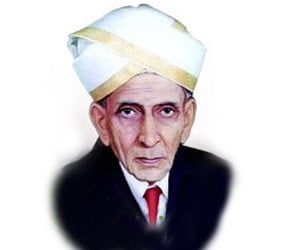
Sir M Visvesvaraya

M. Visvesvaraya Biography

M Visvesvaraya


Born: September 15, 1860
Died: April 14, 1962
Achievements: Architect of Krishnarajasagar Dam; devised steel doors to stop the wasteful flow of water in dams; honored with Bharat Ratna.


Sir Mokshagundam Visvesvaraya was an eminent engineer and statesman and played a key role in building of modern India.


Sir M. Visvesvaraya was born on September 15, 1860 in Muddenahalli village in the Kolar district of the erstwhile princely state of Mysore (present day Karnataka). His father Srinivasa Sastry was a Sanskrit scholar and Ayurvedic practitioner. His mother Venkachamma was a religious lady. He lost his father when he was only 15 years old.


Visvesvaraya completed his early education in Chikkaballapur and then went to Bangalore for higher education. He cleared his B.A. Examination in 1881. He got some assistance from the Government of Mysore and joined the Science College in Poona to study Engineering. In 1883 he ranked first in the L.C.E. and the F.C.E. Examinations (equivalent to B.E. Examination of today).


When Sir M. Visvesvaraya cleared his engineering, Government of Bombay offered him a job and appointed him Assistant Engineer at Nasik. As an engineer, he achieved some marvelous feats. He planned a way of supplying water from the river Sindhu to a town called Sukkur. He devised a new irrigation system called the Block System. He devised steel doors to stop the wasteful flow of water in dams. He was the architect of the Krishnaraja Sagara dam in Mysore. The list is endless.


Sir M. Visvesvaraya lead a very simple life. He was a strict vegetarian and a teetotaler. He was known for his honesty and integrity. In 1912, Maharaja of Mysore appointed Visvesvaraya as his Dewan. Before accepting the position of Dewan of Mysore, he invited all his relatives for dinner. He told them very clearly that he would accept the prestigious office on the condition that none of them would approach him for favours. As Dewan of Mysore, he worked tirelessly for educational and industrial development of the state. When he was the Dewan many new industries came up. The Sandal Oil Factory, the Soap Factory, the Metals Factory, the Chrome Tanning Factory , were some of them. Of the many factories he started the most important is the Bhadravati Iron and Steel Works.


Sir M. Visvesvaraya voluntarily retired as Dewan of Mysore in 1918. He worked actively even after his retirement. Sir M. Visvesvaraya was honored with Bharat Ratna in 1955 for his invaluable contribution to the nation. When he reached the age of 100, the Government of India brought out a stamp in his honor. Sir Visvesvaraya passed away on April 14, 1962 at the age of 101.


Every year, 15 September is celebrated as the Engineer’s Day in India in his memory.


Some of the honours and laurels conferred on Sir M. Visvesvaraya
  • 1904: Honorary Membership of London Institution of Civil Engineers for an unbroken period of 50 years
  • 1906: "Kaisar-i-Hind" in recognition of his services
  • 1911: C.I.E. (Companion of the Indian Empire) at the Delhi Darbar
  • 1915: K.C.I.E. (Knight Commander of the Order of the Indian Empire)
  • 1921: D.Sc. - Calcutta University
  • 1931: LLD - Bombay University
  • 1937: D.Litt - Benaras Hindu University
  • 1943: Elected as an Honorary Life Member of the Institution of Engineers (India)
  • 1944: D.Sc. - Allahabad University
  • 1948: Doctorate - LLD., Mysore University
  • 1953: D.Litt - Andhra University
  • 1953: Awarded the Honorary Fellowship of the Institute of Town Planners, India
  • 1955: Conferred ' BHARATHA RATNA'
  • 1958: 'Durga Prasad Khaitan Memorial Gold Medal' by the Royal Asiatic Society Council of Bengal
  • 1959: Fellowship of the Indian Institute of Science, Bangalore


The Samadhi of Sir M.V. at Muddenahalli
The Bharat Ratna medal
Sir M. Visvesvaraya institute of technology Photo
Sir M. Visvesvaraya institute of technology
Sir M. Visvesvaraya Photo
    back to top